Swimming Rules, Pool Specs & Physical Education MCQs
Swimming is an Olympic sport raced in a 50-meter pool with 10 lanes, featuring four main strokes: freestyle, backstroke, breaststroke, and butterfly. World Aquatics governs the sport globally. Understanding stroke rules, turn regulations, and pool dimensions is essential for physical education exam preparation.
Test your Swimming knowledge. Take a timed test or practice individual questions below.
Take a Test
Select the number of questions and begin your timed assessment
Choose Question Count
or enter custom count
60s per question
Passing: 50%
Question 1 of 10
00:00
Test Complete!
0/0Score
0%Percentage
—Status
00:00Time Taken
6Total Questions
0Answered
0Correct
0%Score
1How long is an Olympic swimming pool?
A. 25 meters
B. 50 meters
C. 75 meters
D. 100 meters
2How many lanes are in an Olympic swimming pool?
A. 6 lanes
B. 8 lanes
C. 10 lanes
D. 12 lanes
3Which stroke requires a frog kick?
A. Freestyle
B. Backstroke
C. Breaststroke
D. Butterfly
4Which stroke requires a dolphin kick?
A. Freestyle
B. Backstroke
C. Breaststroke
D. Butterfly
5What is a tumble turn used in?
A. Freestyle and backstroke
B. Breaststroke only
C. Butterfly only
D. All strokes
6What happens if a swimmer false starts?
A. Warning
B. Disqualification
C. Time penalty
D. Lane change
Quiz Complete!
You answered 0 out of 0 questions correctly.
Rules & Regulations
Master the complete rules of Swimming.
Dimensions
Court, pitch, and equipment measurements.
Practice MCQs
Test your knowledge with interactive quizzes.
10 FAQs
Most frequently asked questions answered.
Detailed Overview
Swimming is an individual or team racing sport that requires the use of one's entire body to move through water. It is one of the most popular Olympic sports, featuring four main strokes: freestyle, backstroke, breaststroke, and butterfly. Swimming demands endurance, technique, and breath control.
Key Topics for MCQ Preparation
Focus on these important topics when preparing for Swimming MCQs in physical education exams:
Team Composition
Number of players, positions, and substitutions
Match Duration
Quarters, halves, periods, and time limits
Field Dimensions
Court, pitch, and equipment measurements
Fouls & Penalties
Violations, cards, and penalty systems
Governing Bodies
International and national organizations
Major Tournaments
World cups, championships, and premier events
Rules & Scoring
How points are scored and matches are won
Techniques & Skills
Key techniques, strokes, and playing styles
Rules & Regulations
Swimming competitions are held in pools (25m short course or 50m long course).
Freestyle allows any stroke, but front crawl is universally used.
Backstroke requires swimmers to start in the water and remain on their back.
Breaststroke requires simultaneous arm and leg movements with a frog kick.
Butterfly requires simultaneous arm recovery over the water and a dolphin kick.
In freestyle and backstroke, swimmers may turn using a tumble (flip) turn.
In breaststroke and butterfly, both hands must touch the wall simultaneously.
A false start results in disqualification.
Pitch / Court Dimensions
Olympic pool length: 50 meters (long course)
Short course pool length: 25 meters
Pool width: 25 meters (10 lanes)
Lane width: 2.5 meters per lane
Minimum pool depth: 1.35 meters (recommended 2-3 meters)
Starting block height: 0.5-0.75 meters above water
Lane rope diameter: 10-15 cm
Swimsuit regulations: no full-body suits (post-2010 rules)
Quick Facts at a Glance
SportSwimming
Players per TeamSwimming competitions are held in pools (25m short course or 50m long course).
Match FormatFreestyle allows any stroke, but front crawl is universally used.
Key DimensionOlympic pool length: 50 meters (long course)
Frequently Asked Questions
Find answers to the most common questions about Swimming.
What are the four main swimming strokes?
The four main competitive strokes are freestyle (front crawl), backstroke, breaststroke, and butterfly. The individual medley (IM) combines all four in the order butterfly, backstroke, breaststroke, freestyle.
What is the difference between long course and short course swimming?
Long course pools are 50 meters long, used in Olympics and World Championships. Short course pools are 25 meters long, used in many national and regional competitions. Short course times are generally faster due to more turns.
What is the individual medley (IM)?
The IM is a race where a single swimmer swims all four strokes in a specific order: butterfly, backstroke, breaststroke, and freestyle. Common distances are 200m and 400m IM.
What is a flip turn in swimming?
A flip turn is a turning technique used in freestyle and backstroke where the swimmer somersaults at the wall and pushes off in the opposite direction without touching the wall with their hands. It saves time compared to open turns.
What is the streamline position in swimming?
The streamline position is the most hydrodynamic body position, with arms extended overhead, hands stacked, biceps squeezing the ears, and body fully extended. It is used off starts and turns to minimize drag.
What is the dolphin kick in swimming?
The dolphin kick is a undulating leg motion used in butterfly, where both legs move together in a whip-like motion. It is also used underwater off starts and turns in freestyle and backstroke for maximum speed.
What are the starting block rules in swimming?
Swimmers start from elevated blocks at the pool edge. The starting signal is given after all swimmers are stationary. In backstroke, swimmers start in the water gripping the starting grips. A false start results in disqualification.
What is the 15-meter rule in swimming?
The 15-meter rule limits the distance a swimmer can travel underwater after a start or turn to 15 meters. The swimmer must surface before the 15-meter mark in freestyle, backstroke, and butterfly. This rule does not apply to breaststroke.
What is the difference between a relay and individual event?
In individual events, one swimmer swims the entire race. In relays, four team members each swim a portion. In medley relays, each swimmer swims a different stroke in the order backstroke, breaststroke, butterfly, freestyle.
What are the major international swimming competitions?
The major competitions are the Olympic Games (every 4 years), FINA World Championships (every 2 years), and Continental Championships. World Aquatics (formerly FINA) is the international governing body for swimming.


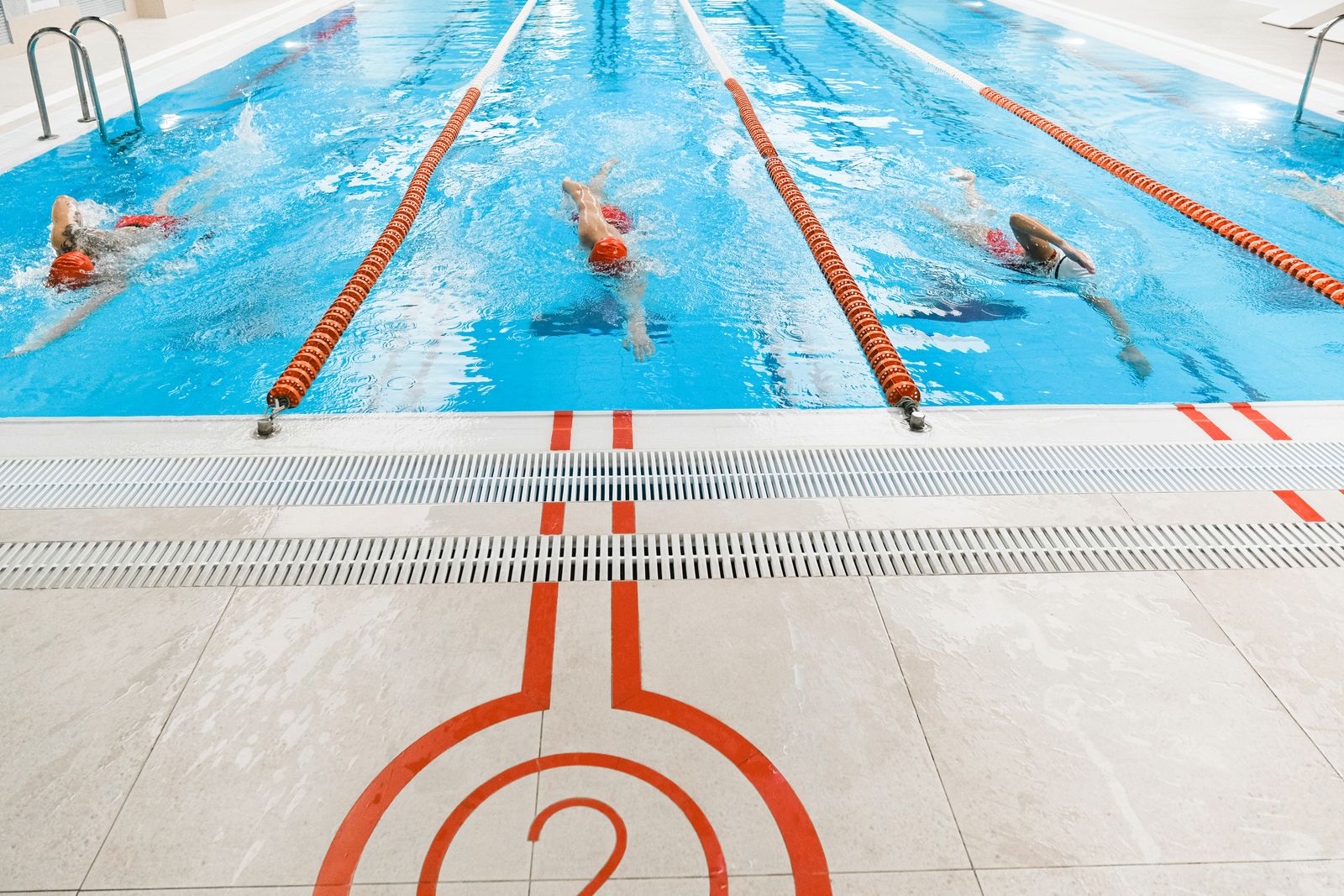
 Glide Through Water