Basketball is played on a 28m x 15m court with 5 players per team aiming to score through a 3.05m-high hoop. FIBA governs international basketball, with the sport being Olympic since 1936. Mastering shot clock rules, fouls, and scoring systems is essential for physical education exam preparation.
Test your Basketball knowledge. Take a timed test or practice individual questions below.
Take a Test
Select the number of questions and begin your timed assessment
Choose Question Count
or enter custom count
60s per question
Passing: 50%
Question 1 of 10
00:00
Test Complete!
0/0Score
0%Percentage
—Status
00:00Time Taken
6Total Questions
0Answered
0Correct
0%Score
1How many players from each team are on a basketball court?
A. 4 players
B. 5 players
C. 6 players
D. 7 players
2How many points is a free throw worth?
A. 1 point
B. 2 points
C. 3 points
D. 4 points
3How high is a basketball hoop?
A. 2.5 meters
B. 3.05 meters
C. 3.5 meters
D. 4 meters
4How many seconds are on the shot clock in FIBA basketball?
A. 20 seconds
B. 24 seconds
C. 30 seconds
D. 35 seconds
5How many personal fouls cause a player to foul out in FIBA?
A. 4 fouls
B. 5 fouls
C. 6 fouls
D. 7 fouls
6How many points is a shot from beyond the three-point line worth?
A. 2 points
B. 3 points
C. 4 points
D. 5 points
Quiz Complete!
You answered 0 out of 0 questions correctly.
Rules & Regulations
Master the complete rules of Basketball.
Dimensions
Court, pitch, and equipment measurements.
Practice MCQs
Test your knowledge with interactive quizzes.
10 FAQs
Most frequently asked questions answered.
Detailed Overview
Basketball is a team sport where two teams of five players each compete to shoot a ball through the opponent's hoop while preventing the other team from scoring. It is one of the most popular sports globally and has been an Olympic sport since 1936.
Key Topics for MCQ Preparation
Focus on these important topics when preparing for Basketball MCQs in physical education exams:
Team Composition
Number of players, positions, and substitutions
Match Duration
Quarters, halves, periods, and time limits
Field Dimensions
Court, pitch, and equipment measurements
Fouls & Penalties
Violations, cards, and penalty systems
Governing Bodies
International and national organizations
Major Tournaments
World cups, championships, and premier events
Rules & Scoring
How points are scored and matches are won
Techniques & Skills
Key techniques, strokes, and playing styles
Rules & Regulations
Each team has 5 players on the court.
A game consists of 4 quarters (12 minutes in NBA, 10 minutes in FIBA).
A field goal inside the three-point line is worth 2 points.
A field goal from beyond the three-point line is worth 3 points.
A free throw is worth 1 point.
Teams have 24 seconds to attempt a shot (shot clock).
Personal fouls result in free throws or possession changes.
A player fouls out after 5 (FIBA) or 6 (NBA) personal fouls.
Pitch / Court Dimensions
Court length: 28 meters (91.9 feet) FIBA / 28.65m (94 feet) NBA
Court width: 15 meters (49.2 feet) FIBA / 15.24m (50 feet) NBA
Hoop height: 3.05 meters (10 feet)
Hoop diameter: 45.7 cm (18 inches)
Backboard width: 1.8 meters (6 feet)
Free throw line distance: 4.6 meters (15 feet) from backboard
Three-point line: 6.75m (FIBA) / 7.24m (NBA) from basket
Ball circumference: 74.9-78 cm (men's size 7)
Quick Facts at a Glance
SportBasketball
Players per TeamEach team has 5 players on the court.
Match FormatA game consists of 4 quarters (12 minutes in NBA, 10 minutes in FIBA).
Key DimensionCourt length: 28 meters (91.9 feet) FIBA / 28.65m (94 feet) NBA
Frequently Asked Questions
Find answers to the most common questions about Basketball.
What is the triple-double in basketball?
A triple-double is when a player records double-digit numbers in three statistical categories (points, rebounds, assists, steals, or blocks) in a single game. It demonstrates all-around excellence.
What is the shot clock in basketball?
The shot clock limits the time a team has to attempt a shot. In FIBA and NBA, it is 24 seconds. If the ball does not hit the rim or go in within 24 seconds, possession is turned over to the opposing team.
What is the difference between a personal foul and a technical foul?
A personal foul involves illegal physical contact with an opponent. A technical foul is a non-contact violation such as unsportsmanlike behavior, arguing with officials, or rule infractions. Technical fouls result in free throws.
What is a pick and roll in basketball?
A pick and roll is an offensive play where a player sets a screen (pick) for the ball handler, then moves (rolls) toward the basket to receive a pass. It is one of the most fundamental and effective plays in basketball.
What is the difference between NBA and FIBA rules?
NBA uses 12-minute quarters, a 23.75-foot three-point line, and 6 fouls for ejection. FIBA uses 10-minute quarters, a 22.15-foot three-point line, and 5 fouls for ejection. The court dimensions also differ slightly.
What is a fast break in basketball?
A fast break is an offensive strategy where a team moves the ball quickly up the court after gaining possession, aiming to score before the defense can set up. It often involves outnumbering the defenders.
What is the restricted area in basketball?
The restricted area is a semi-circle under the basket where defensive players cannot draw charging fouls. If a defender is within this area and contact occurs, it is a blocking foul on the defender.
What is a double-double in basketball?
A double-double is when a player records double-digit numbers in two statistical categories (e.g., 20 points and 10 rebounds) in a single game. It is a common benchmark for strong individual performance.
What is the alley-oop in basketball?
An alley-oop is an offensive play where one player throws the ball near the basket, and a teammate jumps, catches the ball in mid-air, and scores in one motion, usually with a dunk.
What is the FIBA Basketball World Cup?
The FIBA Basketball World Cup is the international basketball championship for national teams, held every 4 years. It is organized by FIBA and is the most prestigious international basketball tournament alongside the Olympics.


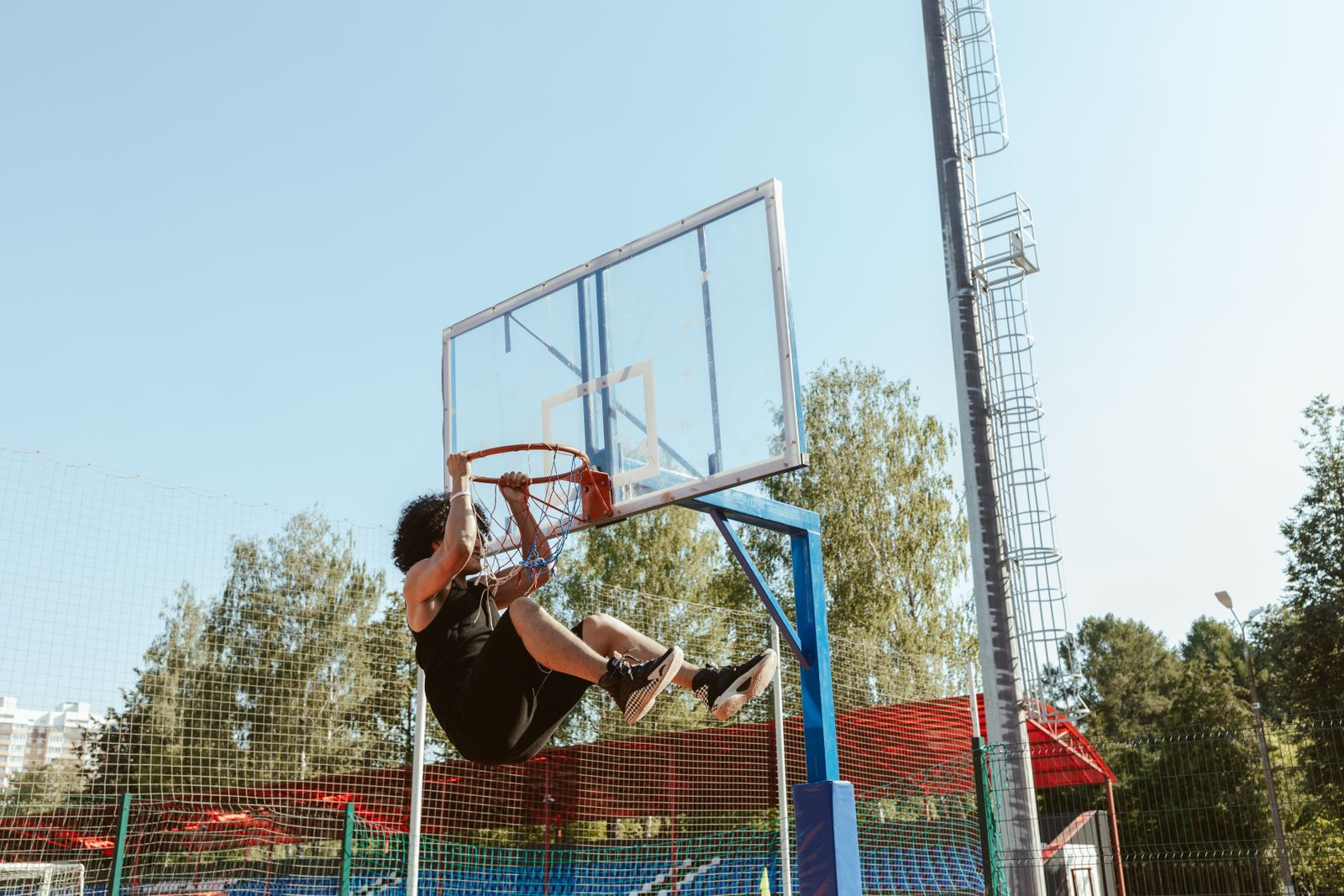
 Above the Rim